
Safe Set Learning for Black-Box Robot Systems
I came up with this project idea by asking how we should think about safety when our models are wrong or incomplete, which is almost always the case on real robots. I liked that control barrier functions give really nice theory and are widely used, but I wanted to see if you could keep that structure while letting experience drive what “safe” actually means instead of relying on fixed hand‑tuned rules.
We implemented a dual‑GP setup: one GP learns the dynamics residual so the safety filter reasons over a corrected model with uncertainty, and the second GP learns a barrier‑like safety score from rollouts, capturing how the safe set tightens near boundaries or under disturbances. Together they drive a robust CBF QP that filters any nominal controller online, plus a SafeOpt‑style Bayesian optimizer that probes the current safe frontier to steadily grow the certified safe region.
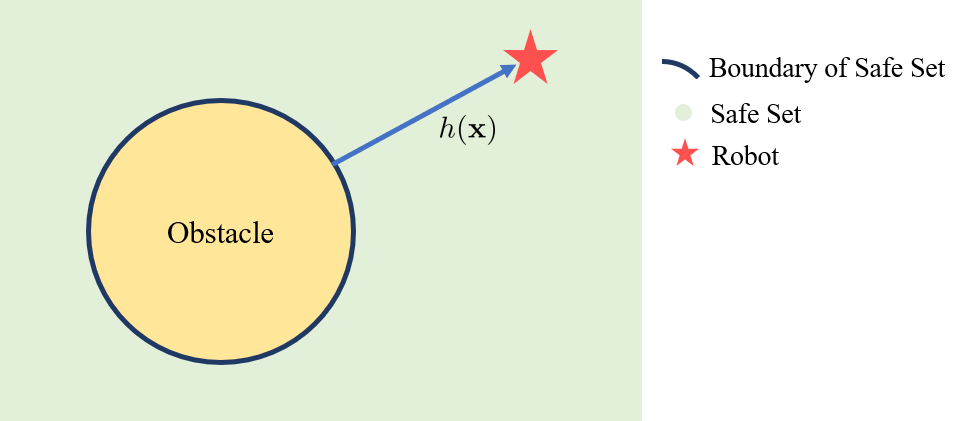
In a simple 1D double‑integrator with unknown wind, this combo adapted to model mismatch, expanded the verified safe set over episodes, and avoided constraint violations, beating both plain LQR and a mismatched analytic CBF. The hardest part is still how we label “safe vs. unsafe” for the barrier GP without ever crashing anything (it’s a bit heuristic right now) but promising enough that I’d like to revisit this line of work later.
| 👉 [Code Available upon Request] | 📄 Full Report (PDF) |